
Rocky Point Closing Costs and Fees: Planning the Complete Purchase Budget
Closing costs in Mexico include taxes, trust-related expenses, government charges, and professional services that buyers may not encounter in the same form at home. The largest expense in many transactions is the municipal tax on the transfer of real property. Foreign buyers may also have costs associated with establishing, modifying, or transferring a Mexican bank trust (fideicomiso).
p>I want buyers to know about these expenses before they become attached to a property. I say it as early and as often as I can.
A Planning Formula, Not a Guaranteed Quote
For many conventional transactions, I currently tell buyers to begin planning around:
2026 Puerto Peñasco transfer-tax rate
tr>tr>tr>| Property value | Rate described for 2026 |
|---|---|
| Up to 2.5 million pesos (roughly US$135,000–$140,000 at recent exchange rates) | 2.5% |
| Above 2.5 million pesos (roughly US$140,000 and up) | 3% |
Why two identically priced properties can cost differently to close
Some costs are based on the property's taxable value or transaction value, while others are relatively fixed. A notario, title certificate, registration, permit, closing coordination, and trust-related work do not all rise proportionally with the purchase price.
That means fixed expenses represent a much larger percentage of an inexpensive property than of a high-priced property. Two identically priced properties can have different closing costs.
What the total may depend on
- The property's value used for tax purposes
- The applicable municipal transfer-tax rate
- Whether an existing bank trust can be used or modified
- Whether a new trust is needed
- The trustee bank and its current charges
- Whether the buyer or seller is a Mexican citizen or foreign person
- Appraisal, survey, registration, permit, and certificate requirements
- Prorated taxes, HOA dues, utilities, or rental income
- The financing and closing structure
- The condition of the existing title and ownership documents
The two big categories
1. Municipal transfer tax. For the buyer, the municipal real-estate transfer tax is commonly the largest single item.
p>2. Trust and formal closing costs. The costs required to create, modify, or assign the bank trust and complete the formal closing: the notario, government permits, registry and certificate work, trustee-bank charges, legal or closing coordination, and related services.
p>The final statement may have ten to twenty line items. Some are large and others small, but together they complete the transaction.
When You Receive the Estimate and How Timing Works
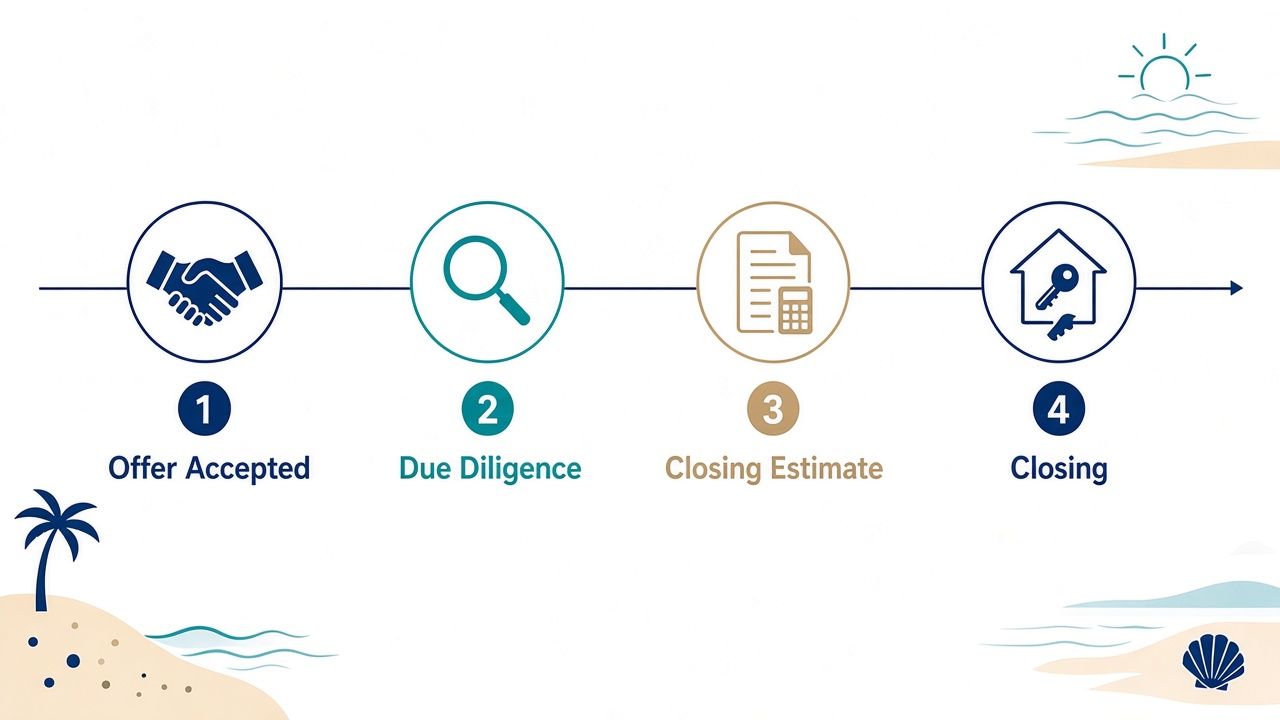
The first meaningful estimate is usually prepared after the offer has been accepted and the closing professionals have reviewed the property and proposed structure.
The estimate can change because of prorations, the final closing date, newly identified document work, or other property-specific requirements. It should nevertheless be substantially more reliable than a generic website percentage.
Inspection, earnest money, and escrow
- Inspection: commonly paid during due diligence, but not normally included in the closing-cost estimate. li>
- Earnest money: deposited into escrow and later credited or disbursed in accordance with the contract and escrow instructions. It is not an additional fee. li>
- Remaining funds: many remaining buyer funds and closing expenses are funded through escrow shortly before closing. The closing statement should show how the earnest deposit is credited. li>
Financing and deferred costs
Financing can change when certain trust and transfer expenses are paid. In some seller-financed structures, final transfer work may occur after the balance has been paid, which can reduce the amount due at the beginning without necessarily reducing the total long-term transaction cost.
The buyer should receive a written explanation of what is being paid now, what is deferred, what triggers the later transfer, and what happens if the financing agreement is not completed.
Prorations
Property taxes, HOA dues, utilities, and sometimes rental income or reservations are adjusted according to the closing date and contract. If the seller has prepaid an expense covering a period after closing, the buyer may reimburse the seller for the buyer's share. If the seller owes an expense attributable to the seller's ownership period, it is normally paid or deducted from the seller's proceeds rather than shifted to the buyer without explanation.
Who commonly pays what
tr> tr>| Buyers commonly pay | Sellers commonly pay | Depends on the contract |
|---|---|---|
| Transfer tax; expenses of acquiring or modifying bank-trust rights | Brokerage commissions; seller-side income tax or capital-gains liability | Escrow, legal, coordination, corrective title work, concessions, and other items |
Buyers should rely on the written estimate and final statement rather than a universal list.
After Closing and Watching for Incomplete Quotes
Ongoing ownership costs to anticipate
- Annual bank-trust administration fees
- Municipal property taxes
- HOA dues, if applicable
- Insurance
- Utilities and property maintenance
- Rental management, licensing, and tax compliance if the property will be rented
Properties held in a U.S. LLC
If the property is already owned through a U.S. LLC, buying the LLC instead of changing the bank trust beneficiary may change the closing steps and costs, but it does not automatically eliminate Mexican or U.S. taxes, legal review, or other obligations. Before going this route, read our full buyer guide to buying Rocky Point property with a U.S. LLC.
p>Seeing an unusually low estimate?
- What is included?
- What is excluded?
- What is being paid by the seller?
- What may be deferred until later?
My goal is to repeat the planning estimate early and often, then replace it with the property-specific written estimate as soon as the closing professionals can prepare it.
Common Questions
How much are closing costs in Rocky Point?
For many conventional purchases, start planning around the applicable transfer tax plus about $9,000 to $11,000 in other closing expenses. Your actual amount comes from a property-specific estimate.
What is the transfer tax in Puerto Peñasco?
For 2026, the city's legislative record describes 2.5% for properties valued up to 2.5 million pesos (roughly US$135,000–$140,000) and 3% above that. Confirm the rate and taxable value for your property.
When will I get a closing-cost estimate?
Usually after your offer is accepted. In my recent transactions, buyers often get a useful preliminary estimate within about one and a half to two weeks.
Who pays closing costs, the buyer or the seller?
Buyers commonly pay the transfer tax and the bank trust costs. Sellers commonly pay commissions and any seller-side income or capital-gains tax. Other items depend on the contract.
Can I buy a Rocky Point property that's held in a U.S. LLC?
Yes. If the property is already owned through a U.S. LLC, buying the LLC instead of changing the bank trust beneficiary may change the closing steps and costs. It doesn't automatically eliminate Mexican or U.S. taxes or legal review, so read our full guide to buying with a U.S. LLC first.
p>Ready to plan your Rocky Point budget?
If you are considering a purchase and want help starting with a realistic planning estimate, I can walk through the factors that typically affect the budget and make sure a property-specific closing-cost estimate is requested after an offer is accepted.
Let's Talk About Your Budget📞 +1 520.339.1392 · 638.105.3597